Showing posts with label imitation. Show all posts

1.03.2012

Submitted!

What a joy to log onto my email and see these words:
Thank you for submitting an entry to the 2012 Catalog Essay Contest!
We are grateful for your participation.
Your essay will be reviewed shortly, and a winner will be announced on March 1, 2012.
Now, all I have to do is wait.

I know that I promised to post the full story once the deadline for the contest had passed. However, it was recently brought to my attention that doing so may disqualify me from the contest. Vision Forum was unclear about who holds the rights to my story (they have the right to publish it, etc); so, in order that I may not be disqualified before my story is even read, I will only be posting snippets of the story.

However, if I place First or Honorable Mention (*fervently crosses fingers*) , then Vision Forum will post my story on their website. If I am among the winners, I will be sure to link to their site so you can read the whole story.

For now, here are some more snippets:

A sharp scream split the frozen mist.
I tore my eyes away from the malicious waves battering my ship, and whirled toward the deck. My heart skipped.
“Murdoch!” I called, sprinting from the bridge. The men in the wheelhouse jumped as I flung the door open.
“Captain!” All three of them stood.
I strode toward my First Officer. “Murdoch, what’s going on?”
He stammered, hesitating. “W-what do you mean?”
“On deck! Didn’t you hear the passengers yelling?”
His mustache twitched. Of course he had.
“So why aren’t you doing anything?”
“I left men in charge…” he blurted.
“I put YOU in charge! Do you see what’s happening out there?”
All three men turned and stared out the window. Murdoch looked up reluctantly.
The deck teemed like a disturbed anthill, erupting with a mob of Third Class Passengers, feverishly rushing to escape the sinking ship. Pale-faced men sprinted back and forth, or else bickered with each other, hollering curses. Women and children huddled like frightened sheep, herded toward the lifeboats by the deckhands.
And only one lifeboat remained.
“Do you see the problem now, Murdoch?”
He looked down.
And now to spoil the ending:
I looked around at my men, and they smiled resolutely back at me.
I couldn’t bear their loyalty. Not after I had been so heartless to the one woman in my life who deserved all of my loyalty and love. My men were putting me first, but I hadn’t put her before myself.
I had denied my responsibility as a man: to protect.
I glanced down at the little girl. My chance to make things right. Then I knelt, and slipped my jacket over her head.
My smile was tainted by tears.
I would go down with my ship. Redeemed.
But Sarah would never know.

(However, considering the historical fact that Captain Edward Smith did, in fact, sink with his ship, the end is already spoiled. The surprises are all in the middle, and I didn't spoil any of those.)

Now, one announcement before I go. There will, in fact, be a contest this month:

The theme? IMITATION
 
The Assignment? To write a poem of at least 100 lines in imitation of a specific poem selected from one of the masters (E. Poe, H. Longfellow, R. Frost).

There will be a forthcoming post on Imitation, along with an example 'imitation poem'. After that  the formal Contest Announcement will be posted (along with the deadline and description of the prize), and then
AWAY TO YOUR PENS!

And, UNTIL then . . . well . . . away to your pens, I suppose!
 

11.11.2011

Poetry According to Poe

I've said before that imitation is the first step to greatness.

Oh. 

I didn't?

Well it is. It's also the highest form of flattery. And I'm sure Edgar Allen Poe would be flattered to know how many poets have imitated his Raven. He did give us a guide, after all.

His essay, published in 1846, entitled The Philosophy of Composition.

In his own words: "I have [no] difficulty in recalling to mind the progressive steps of any of my compositions; and, since the interest of an analysis, or reconstruction, such as I have considered a desideratum, is quite independant of any real or fancied intrest in the thing analyzed, it will not be regarded as a breach of decorum on my part to show the modus operandi by which some one of my works was put together."

What a gift for us poets!

"I select The Raven as the most generally known. It is my design to render it manifest that no one point in its composition is referrible either to accident or intuition - that the work proceeded, step by step, to its completion with the precision and rigid consequence of a mathematical problem."

The 'step-by-step process' is as follows:

1.       Determine the length that you wish your poem to be. The length will be based on what you wish to convey with your poem, whether it is one, unified message, or several messages in one story. However, Poe says, "there is a distinct limit, as regards length, to all works of literary art - the limit of a single sitting." For "a poem is such only inasmuch as it intensely excites, by elevating the soul; and all intense excitements are, through a psychal necessity, brief.
2.       Choose the impression, or effect, you want your poem to have. Poe says that he always chooses the effect first, and then proceeds through the rest of the poem with this overall effect in mind.  What is your theme? Beauty? Love? Honor? And who is your audience? Is this a universal poem? Or is it a poem directed at lovers, searchers, thinkers? Those who are lonely, empty, hopeful?
3.       Consider the tone of the poem. Even if your theme has been touched upon before, there are various ways to touch upon it. Beauty, written about with a tone of sadness, becomes something different. The message itself changes, becomes unique.
4.       Decide upon meter, etc.
5.       Identify key words in the poem, such as Poe’s "Nevermore" in The Raven. Poe calls this a 'refrain'. Though not all poems need one, a certain amount of repetition is crucial for the overall effect and the "intense excitement" of the poem. Also identify key characters, such as the Raven Poe picked to intone his refrain.
6.       Now combine the tone and the theme. Think of your tone, and things related to it. If your tone is melancholy, the first things that come to mind are death, despair, and loss. Then think of your theme, and how your desired tone could be made to relate to this theme. Beauty even in death? Loss of beauty?
7.       Combine your key words with this combined theme-and-tone.
8.       Envision the climax of your poem and compose it. Thus you will also establish your poem's meter, etc.
9.       Brainstorm the poem’s location and order of events.
10.   At this point, it would seem that the poem is ready to be written. However, Poe digs even deeper. "In subjects so handled," he says, "however skilfully, or with however vivid an array of incident, there is always a certain hardness or nakedness which repels the artistical eye." The bare events of the poem, written in meter, is not enough to evoke the intensity needed to make the poem a work of art. Two things, Poe says, are required: Complexity of the plot and personalities, and some amount of suggestiveness, some "undercurrent" as Poe calls it, through ulterior motives/hidden messages. Thus layers upon layers are added to the poem, giving it depth and reality.
These guidelines always make me smile when I read them.
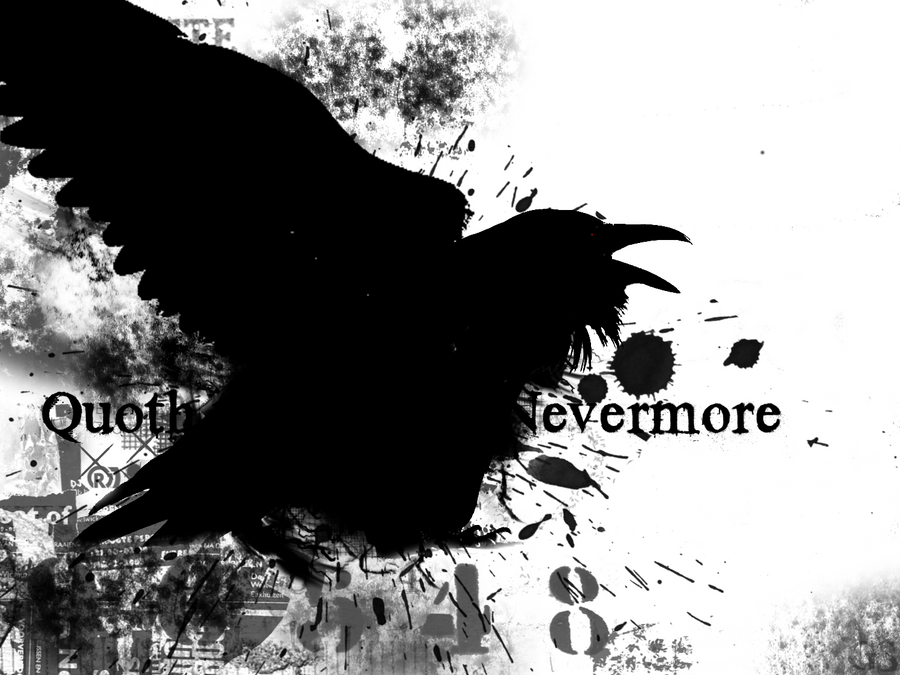
I guess they encourage me...but I think they excite me more then anything else. I can't wait to grab a pencil and start writing - delve in deep to the complexities; grab hold of an old theme and twist it a new way; find my own Raven, above my own chamber door, quothing my own 'Nevermore'. 

And how could I go wrong, with Poe himself to lead me through the dark tangles of Poe-try?